
Building QI Capacity at CAMH:
Supporting meaningful collaboration, applied learning, and shared approaches

Building meaningful and sustainable quality improvement (QI) across a large organization requires alignment, prioritization, and practical support. Over the past year, the Centre for Quality Improvement and Patient Safety partnered with CAMH to deliver a structured workshop series designed to help teams translate strategic priorities into actionable QI initiatives. Delivered over three sessions between June 2025 and March 2026, the workshop series was intentionally designed as a longitudinal experience which allowed participants to build skills over time, apply learning between sessions, and return with reflections and progress on their initiatives.
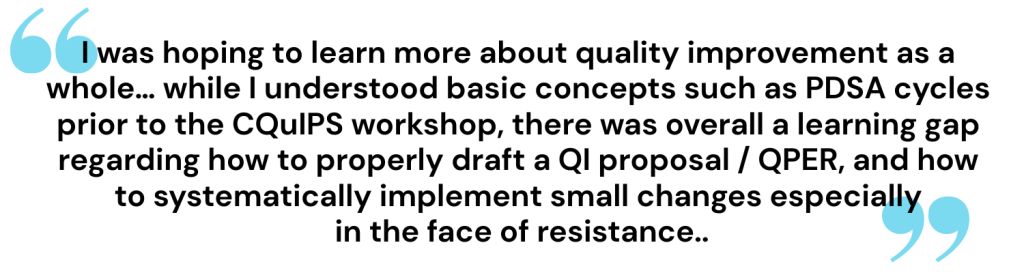
In a pre-session survey, participants highlighted a clear need for hands-on skills and guidance on how to apply practical QI to their day-to-day work. As one participant noted,
Teams were encouraged to identify how their current initiatives could align with and advance strategic priorities, rather than adding additional burden. The workshop activities were tied directly to real projects that immediately translated to concepts into action within the local context. This practical approach not only built individual competencies but also strengthened team-based problem solving for sustainable QI work. For the first session, participants were provided with patient safety and quality data summaries, creating a shared foundation for discussion and helping teams explore how existing data could inform their improvement work.The workshops brought together a diverse group of participants, including physicians, Advanced Practice Care Leaders (APCLs), patient safety specialists, and administrative staff. This interdisciplinary mix supported shared learning and fostered a more cohesive approach to improvement across CAMH allowing teams to align around common goals. Participants represented 20+ program areas and portfolios including Access to Care, Child & Youth, Addictions/COMPASS, Forensics, Geriatrics, Professional Practice, QuEST, and EPMO. The value of the interdisciplinary and longitudinal workshop format was clearly noted by the group, one stating that it “helped foster discussions and learning from colleagues who brought diverse clinical expertise, discipline-specific perspectives, and personal insights.” They also emphasized that the multi-session structure helped build familiarity, strengthen connections, and support ongoing collaboration over time.
Across the workshops, participant feedback highlighted a consistently positive and engaging learning experience. Many described the sessions as interactive, well-structured, and highly relevant to their day-to-day work. The workshops also created space for collaboration and shared learning, with participants emphasizing how useful it was to engage with colleagues across roles and program areas. Participants described a shift in how they approached improvement work and emphasized how the sessions helped bridge the gap between theory and application. One participant reflected that the workshop “never felt like a long lecture but rather a series of activities,” making the learning both engaging and relatable to the realities of everyday work.

A particularly meaningful shift described by participants was the importance of prioritizing problem definition before moving to solutions. As one participant reflected, the workshops brought to life the essence of QI as “bringing together those closest to the issue to deeply understand concerns and gaps, validate ideas, and use data to drive meaningful change.”
As CAMH continues to strengthen its quality governance and expand QI capacity, initiatives like this workshop series play an important role in bridging the gap between strategy and execution. Reflecting on the partnership, Gillian Judkins, Director of Clinical Quality, Experience and Safety at CAMH, shared:

Thank you to the team at CAMH who openly shared their feedback and experiences to support this story and the continued development of our QI Capacity Building workshops.